
In 1981, a tiny advertising agency in Minneapolis took out a full-page ad in the local newspaper. It was addressed to the entire American advertising industry, which was not, by and large, reading the Minneapolis papers. The ad announced that Fallon McElligott Rice was open for business, and that it was looking for clients who would “rather outsmart the competition than outspend them.” It described imagination as “one of the last remaining legal means you have to gain an unfair advantage over your competition.”
This was not a modest claim for a five-person agency in the Midwest. Madison Avenue, which had always been the centre of American advertising, was not especially threatened. But within three years, Advertising Age had named Fallon its Agency of the Year. At the time of the award, the agency had 38 employees, all under 40, and their most celebrated work had been done for a local barber and a church.
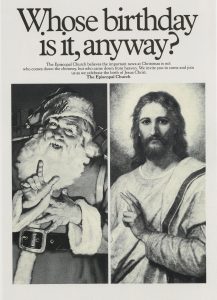
The Episcopal Church had hired Fallon as one of its first national clients, and the resulting campaign is still talked about. The most famous ad placed a picture of Jesus Christ next to a picture of Santa Claus and asked, simply: “Whose birthday is it anyway?” It was sharp, a little provocative, and entirely serious. It treated its audience as people capable of being surprised into thinking rather than guilted into compliance. One writer, looking back at the campaign decades later, said simply: better ads for a church have never been written.
What made Fallon different was a philosophy, not a style. Tom McElligott, the agency’s creative director, used to say that his aim was to give clients “the sort of advertising that makes the palms sweat a little, that makes you a bit nervous.” He meant this as a compliment. The nervousness was a sign that the work was doing something real, that it was making an argument rather than offering reassurance. Safe advertising, in his view, was not safe at all: it was just expensive wallpaper.
The manifesto the agency nailed to the door of the advertising industry in 1981 has been described, with some affection, as “Lutheran punk rock.” It was a deliberate rejection of the dominant approach of the era, which was to buy so much media time that your jingle became inescapable. Fallon’s counter-argument was simple: if you can’t outspend your competition, you have to outthink them. Creativity isn’t decoration. It’s strategy.
Charities know, in theory, that they can’t outspend anyone. Most of them are competing for attention against organisations with vastly larger budgets. The rational response to this situation is exactly what Fallon proposed: to be more interesting, more surprising, more worth your audience’s time than the people with deeper pockets.
And yet, the sector’s default mode is still largely the opposite: cautious, deferential, reluctant to make anyone’s palms sweat. Causes that could be argued for with intelligence and wit are instead presented as obligations. Appeals that could treat donors as people capable of being genuinely moved by an idea settle instead for the simpler transaction of guilt.
The Episcopal Church, to its credit, hired an agency that believed a church deserved the same quality of thinking as a bank or a beer brand. That the argument could be made sharply, with a single image and four words, without softening the edges or hedging the claim.
The Fallon manifesto was right about one thing above all: imagination is a competitive advantage. For organisations that exist to do good, and that will never have the budgets of the organisations they’re competing against for public attention, it may be the only one worth having.
—
Fuzzy Logic is a series from Hope, a charity communications and fundraising agency. The series explores the imprecise and uncertain world of branding, marketing, persuasion, fundraising, and allied fields, particularly as they apply to charities, social impact businesses, causes and not-for-profits. Written by Michael Isaacs.
Also see this piece about the need to get cut-through in charity advertising and marketing.


Are you like Mark Twain’s cat?
Mark Twain wrote: “If a cat sits on a hot stove, that cat won’t... Read more

The Ideas Lab: Body Image
This is a companion piece to the most recent Ideas Lab on Women’s Football.... Read more

The opera singer at your front door
Home audio is often marketed with the promise: “it’s like the artist is right... Read more